
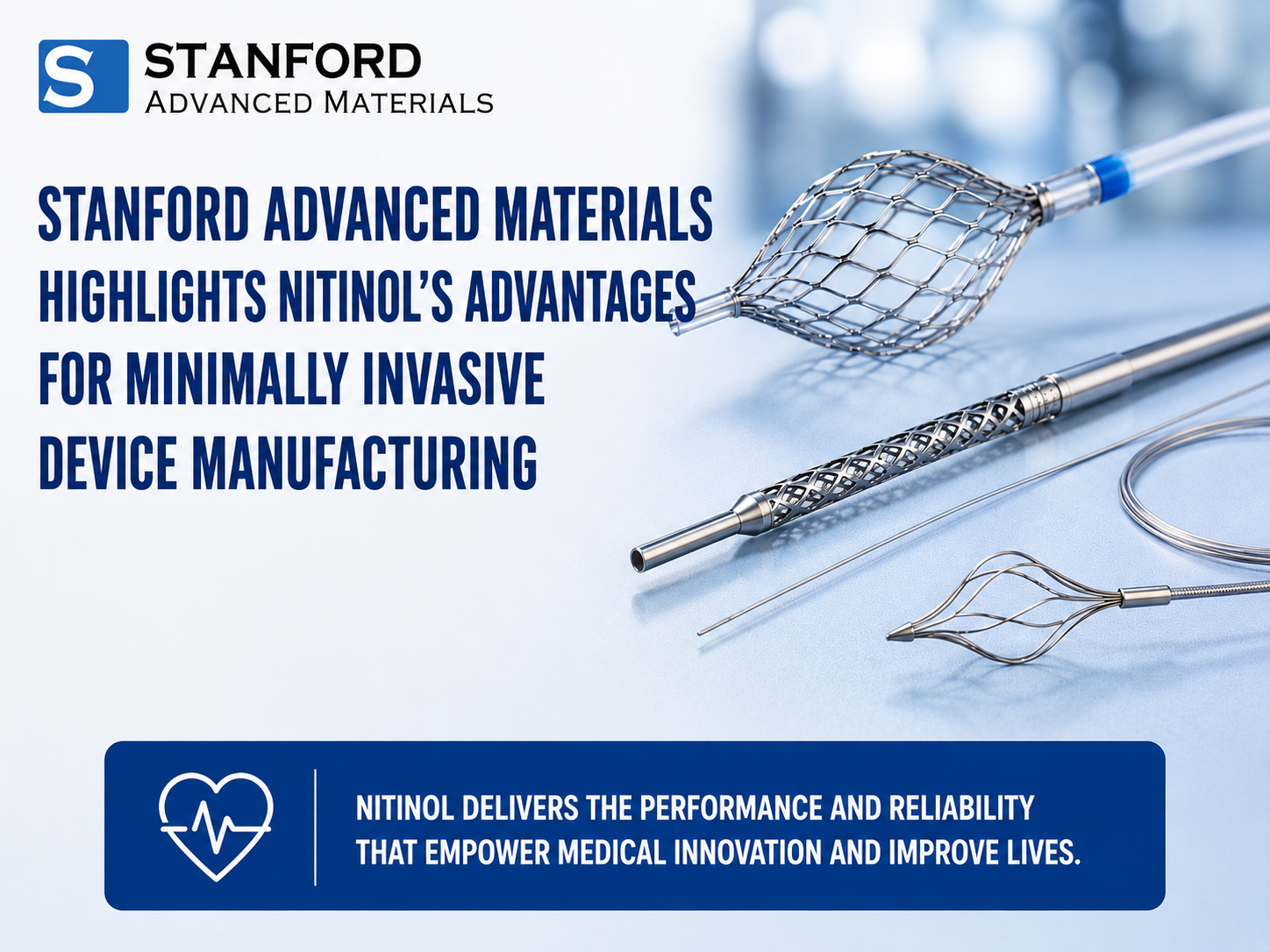
Stanford Advanced Materials (SAM) recommends Nitinol alloys to solve a key problem for medical device makers: devices must be flexible enough to navigate through narrow, winding blood vessels, but rigid enough to provide support once deployed. Nitinol does both.
The Challenge Facing Minimally Invasive Device Manufacturing
According to Grand View Research, the global minimally invasive surgical (MIS) devices market is valued at over US $550 billion and is projected to surpass US $940 billion by 2033. As minimally invasive surgery expands into delicate anatomical territories like cerebral vasculature, device designers face a fundamental materials conflict. Devices must exhibit high flexibility to travel through curved catheters. However, once at the target site, they must provide adequate radial force to dilate vessels, occlude defects, or secure replacement valves.
Conventional metals like stainless steel and cobalt-chromium alloys fall short:
l Plastic Deformation: They have a low elastic strain, making them inadequate for self-expanding applications.
l Stress Shielding: Their high elastic modulus far exceeds human bone, which can cause bone resorption and implant loosening in orthopedic use.
l Fatigue: Long-term pulsatile cyclic loading threatens implant reliability.
Nitinol effectively transcends these physical limitations.
The Unique Properties of Nitinol Alloys Make It Possible
Nitinol, a shape memory alloy, fundamentally transcend the physical limits of conventional materials through two core characteristics, offering a viable pathway to address the challenges outlined above.
1. Superelasticity
According to Scott Robertson’s paper published in International Materials Reviews, Nitinol can sustain recoverable strains of up to 10%—an order of magnitude greater than conventional medical-grade metals. This allows devices to be crimped into exceptionally small profiles for micro-catheters and automatically return to their original shape upon release without balloon dilation. Superelastic nitinol enables