

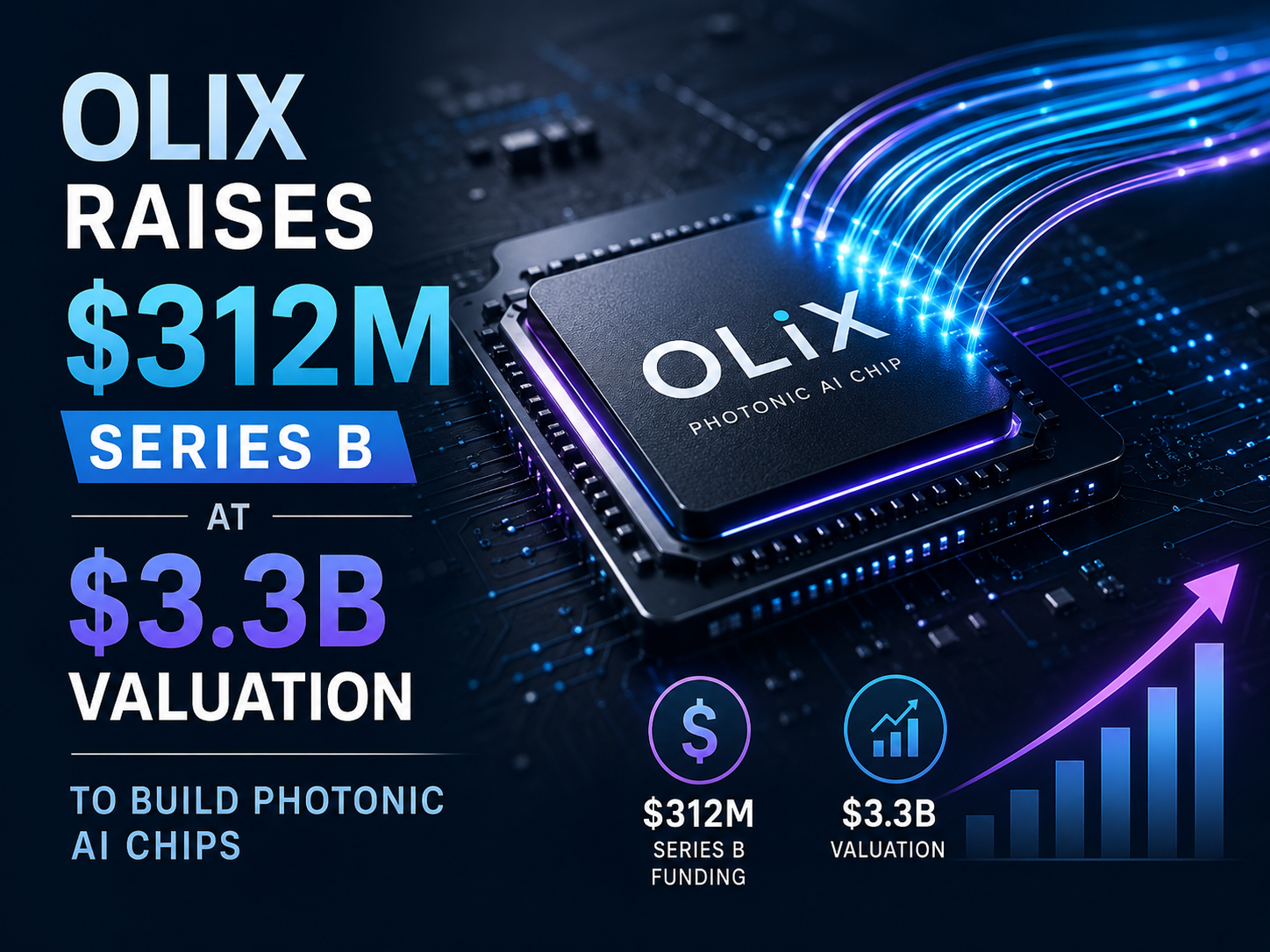
London-based photonic chip startup OLIX has raised $312 million (approximately £246 million) in a Series B round at a $3.3 billion (£2.6 billion) valuation, in what is now Europe’s largest-ever semiconductor funding round. The announcement, made on 3 August 2026, comes just two years after the company was founded and signals growing investor conviction that photonic computing could disrupt the GPU-dominated AI chip market.
What OLIX Is Building
OLIX designs Optical Tensor Processing Units (OTPUs): chips that use light rather than electricity to process AI inference workloads. The company was founded in London in March 2024 by James Dacombe, who was 24 years old at the time, and has quickly become one of the most closely watched deep tech ventures in the UK.
The centrepiece of its product roadmap is the DX-1, a decode accelerator targeting the stage at which an AI model reasons and generates its output. For 100-billion-parameter models, OLIX claims DX-1 can achieve over 10,000 tokens per second per user whilst delivering superior output token throughput per watt compared to general-purpose chips running large batch sizes. The architecture is designed to scale to models of 10 trillion parameters and beyond.
OLIX’s core technical insight is that the AI industry’s prevailing approach of running every stage of token generation on the same general-purpose chip is approaching its efficiency limits. Its systems unroll AI models across many specialised chips, creating a production line where each chip focuses on a single stage of inference. Data travels between chips via a novel optical interconnect, moving at ultra-low latency and energy cost using light rather than copper wiring.
Why OLIX Ditches High-Bandwidth Memory
One of the most strategically significant aspects of OLIX’s design is what it does not use. High-bandwidth memory (HBM), the costly and supply-constrained component underpinning Nvidia’s most powerful data centre GPUs, is absent from OLIX’s architecture entirely. Instead, DX-1 holds models in fast on-chip SRAM, eliminating dependence on the advanced packaging and HBM supply chains that have created bottlenecks across the AI hardware industry.
The global shortage of HBM has constrained GPU production and driven up costs for hyperscalers and AI labs worldwide. A chip architecture that achieves competitive inference performance without requiring HBM could prove attractive on both cost grounds and supply chain resilience grounds, particularly for enterprises and governments seeking greater independence from current semiconductor supply chains.
Who Is Backing OLIX
The Series B round drew a roster of investors that reflects the strategic weight attached to OLIX’s technology. Semiconductor giant Arm, the Cambridge-based company whose chip designs power the vast majority of the world’s smartphones, participated in the round alongside quantitative trading firm Hudson River Trading and investment manager Fundomo.
Reed Hastings, co-founder of Netflix, joined as an angel investor. His involvement adds both profile and a useful signal about how prominent Silicon Valley investor-operators view European AI infrastructure plays. Perhaps most significantly for the UK startup ecosystem, the UK government’s Sovereign AI venture fund committed to the round, a clear statement that photonic computing is now a strategic national priority.
Existing investors Hummingbird Ventures, Crane, Plural, Creandum, Phoenix Court and Transition all increased their commitments, reflecting continued confidence from OLIX’s earliest backers.
Board and Executive Appointments
Professor Nick McKeown has joined the OLIX board of directors. One of the defining figures of modern networking, McKeown co-invented software-defined networking, OpenFlow and P4, and is Professor Emeritus of Computer Science and Electrical Engineering at Stanford University. He won the 2025 Marconi Prize and previously co-founded Nicira (acquired by VMware) and Barefoot Networks (acquired by Intel).
Matt Briers has joined as Chief Financial Officer. Briers spent nine years as CFO of Wise, joining when the company had around 500,000 customers and guiding it to its landmark 2021 direct listing on the London Stock Exchange, which was the exchange’s largest-ever technology listing at a valuation of £8.75 billion. His experience building the finance function for a company that scaled from loss-making startup to major public market participant makes him a well-suited addition as OLIX prepares for rapid scale.
What This Means for UK Tech
OLIX’s Series B is the largest chip funding round in European history. For the UK specifically, it is a landmark. Britain has long punched above its weight in semiconductor design through the global success of Arm, but has historically struggled to build the kind of vertically integrated chip companies with global commercial ambitions that the US and China produce. OLIX is building the full stack: chips, photonics, lasers, compilers and systems software, all developed from London and Bristol.
The company is actively hiring across silicon, photonics, compiler and systems engineering in London and Bristol, with additional roles in Austin, Toronto and San Francisco. Its first chips are expected to reach customers in the second half of 2027. For UK founders and policymakers alike, OLIX is a compelling demonstration that deep technical differentiation in AI infrastructure, backed by sovereign capital and strategic partners, can produce world-class outcomes from British soil.

