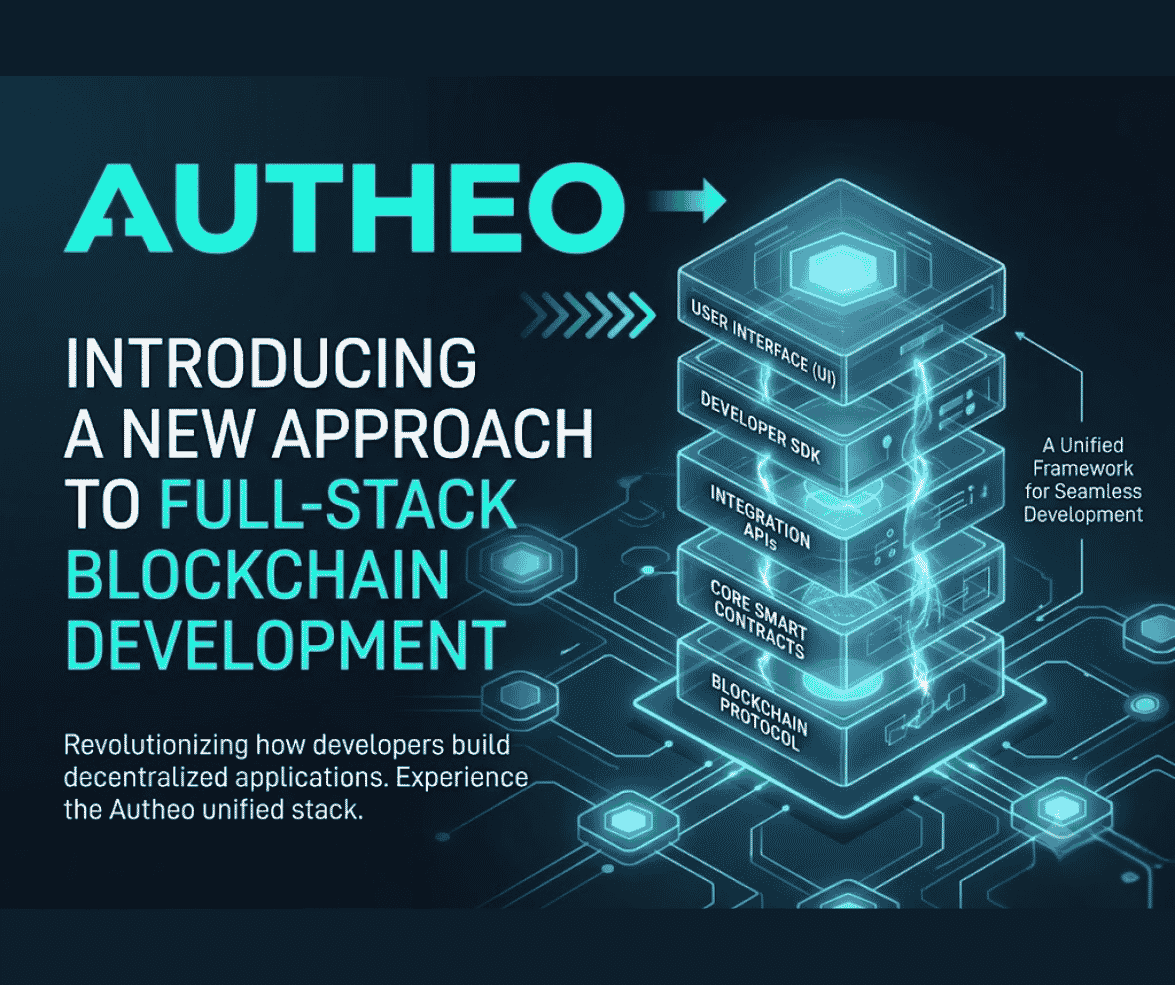
Layer-0 operating system combines an EVM-compatible blockchain, native developer tools, interoperability and an expanding infrastructure ecosystem
Autheo is introducing a different approach to blockchain development by bringing the network, developer environment and supporting infrastructure into one coordinated platform.
Rather than operating solely as a Layer-1 blockchain or providing a single Web3 developer service, Autheo is building a Layer-0 operating system with an integrated Layer-1 blockchain. The platform is designed to unify blockchain execution, developer tooling, identity, compute, storage and AI capabilities within an interoperable environment.
The goal is to address one of Web3 development’s most persistent problems: fragmentation.
Today, developers often need to combine a blockchain, RPC provider, wallet SDK, data indexer, storage service, identity provider, automation platform and cloud environment before they can launch a complete decentralized application.
Each additional provider introduces another integration, account, pricing model, dependency and potential failure point.
Autheo is developing an alternative in which more of the application lifecycle is coordinated through one platform.
What Is Autheo?
Autheo is a Layer-0 operating system with an integrated Layer-1 blockchain and native development environment.
Its architecture is intended to support decentralized applications, sovereign networks, enterprise systems, digital communities, AI agents and new forms of agentic commerce.
Autheo’s broader technology stack is organized around six core components:
- Layer-0 and Layer-1 blockchain infrastructure
- Decentralized compute, storage and messaging
- Full-stack development SDKs
- The Autheo DevHub
- TheoID sovereign identity
- THEO AI and protocol-level AI infrastructure
Some of these components are live today, while others remain in development or are being introduced in stages.
Autheo’s mainnet, transaction fees, validator staking, EVM-compatible execution environment and DevHub are currently available. Decentralized compute, persistent storage, TheoID, THEO AI, AI inference and post-quantum identity features are still rolling out.
This distinction is central to understanding Autheo. It is both a functioning blockchain network and a larger infrastructure platform under continued development.
An EVM-Compatible Blockchain Built on the Cosmos SDK
Autheo’s integrated Layer-1 blockchain is compatible with the Ethereum Virtual Machine and built using the Cosmos SDK.
EVM compatibility gives Solidity developers a familiar development path. Smart contracts built for Ethereum and other EVM-compatible networks can be deployed using widely used tools such as Remix, Hardhat and Foundry.
This allows developers to reuse existing skills, contract patterns and development workflows rather than learning an entirely different smart contract language.
The Cosmos SDK foundation gives Autheo access to native blockchain modules and a different approach to interoperability. Developers can interact with features such as staking through command-line and API interfaces while using IBC to connect with compatible blockchain networks.
For developers, this creates a combination of two established ecosystems:
- Ethereum-compatible smart contract development
- Cosmos-based blockchain architecture and interoperability
Autheo is designed to preserve the familiarity of Solidity while extending development into a broader Layer-0 environment.
DevHub Brings Development Into One Workspace
DevHub is the native development environment at the center of the Autheo platform.
It provides a workspace for testing, deploying and monitoring blockchain applications without forcing developers to leave the Autheo environment for every stage of the application lifecycle.
Autheo’s live developer tooling supports:
- Solidity smart contract development
- Deployment through Remix, Hardhat and Foundry
- Mainnet and testnet workflows
- Automated testing and deployment
- Application monitoring
- Validator and node deployment
- IBC-based cross-chain integration
- Frontend, backend and smart contract SDKs
Autheo describes its SDK strategy as full-stack rather than contract-only. The objective is to support the frontend, backend, smart contracts and orchestration layers of decentralized applications through a more consistent development model.
This differentiates Autheo from infrastructure providers that focus exclusively on RPC endpoints, indexed blockchain data, wallets or individual developer APIs.
Those services remain important, but Autheo’s approach is to connect more of them to the underlying blockchain and development environment.
Addressing the Cost of Web3 Fragmentation
A production decentralized application typically relies on far more than a smart contract.
Developers may need separate services for:
- Blockchain execution
- RPC access
- Wallet connections
- User authentication
- Data indexing
- File storage
- Backend compute
- Smart contract testing
- Deployment automation
- Monitoring
- Cross-chain communication
- AI processing
A development team must evaluate, integrate and maintain every service. If one provider changes its pricing, availability or API, the application may require additional engineering work.
Autheo is designed around the idea that these functions should operate as coordinated parts of a larger system.
The platform’s integrated model is intended to reduce the number of disconnected services developers must manage. Instead of treating identity, infrastructure and AI as unrelated additions, Autheo is building them as components of the same operating environment.
Connecting Web2 and Web3 Development
Autheo is also designed to make blockchain infrastructure more accessible to conventional software teams.
Many businesses are interested in digital ownership, smart contracts or decentralized infrastructure but do not want to rebuild every part of an existing application around blockchain technology.
Autheo’s full-stack approach is intended to support applications that combine conventional frontend and backend development with Web3 execution and ownership.
An application could use traditional interfaces and business logic while relying on the Autheo blockchain for transactions, digital assets, settlement or verifiable records.
This makes the platform relevant to more than crypto-native applications.
Potential use cases include:
- Enterprise applications
- Decentralized finance
- AI agents and agentic commerce
- Gaming and digital assets
- DePIN and connected devices
- Tokenized communities
- Identity-gated applications
- Cross-chain services
- Real-world asset platforms
- Developer infrastructure products
The intended result is an environment where developers can decide which parts of an application belong on-chain and which should use supporting infrastructure without treating them as completely separate systems.
Decentralized Compute and Storage
Autheo is expanding beyond blockchain execution through a planned distributed infrastructure marketplace.
The decentralized compute and storage layers are intended to give applications access to resources supplied by independently owned infrastructure. Potential providers may include data centers, cloud environments, GPU clusters, edge systems and smaller infrastructure operators.
Compute would support application workloads that do not belong directly inside a smart contract. Persistent storage would give applications a way to manage data and digital assets beyond the limitations of blockchain state.
These services are still rolling out and are not fully available as production infrastructure today.
Once available, they are intended to work with the Autheo blockchain, DevHub and THEO utility model. This could allow developers to coordinate settlement, application logic, storage and computing resources within the same broader platform.
TheoID and Sovereign Digital Identity
TheoID is Autheo’s planned identity layer for people, applications, AI agents and digital assets.
Traditional Web3 identity is often reduced to a wallet address. While wallet addresses work for signing transactions, they are not always sufficient for authentication, credentials, permissions or portable digital identity.
TheoID is intended to provide a sovereign identity system that applications can use across the Autheo environment.
Autheo is also developing post-quantum identity capabilities based on NIST-standard cryptographic approaches. These capabilities remain on the roadmap and are not active throughout the current mainnet system.
The longer-term objective is to create identity infrastructure capable of supporting users and autonomous software systems without relying entirely on a centralized identity provider.
Building Infrastructure for AI Agents
Autheo is positioning its platform for a web where autonomous AI agents participate in applications, payments and digital commerce.
An autonomous agent may need to authenticate itself, access computing resources, pay for services, store results and settle transactions. Today, these functions are generally provided through separate centralized systems.
Autheo’s long-term architecture is designed to connect these requirements through blockchain settlement, TheoID, compute, storage and AI infrastructure.
THEO AI and protocol-level AI inference are separate components of this roadmap.
THEO AI is planned as a developer-assistance and orchestration layer for DevHub, network workflows and infrastructure coordination. Protocol-level AI inference is intended to support model requests and decentralized compute workloads through the network.
Neither THEO AI nor protocol-level AI inference is currently live as a production service.
As these components roll out, Autheo plans to support applications involving AI workflow automation, agent identity, verifiable inference and agentic commerce.
How THEO Supports the Autheo Network
THEO is the native utility coin of the Autheo Layer-1 blockchain.
Its currently active uses include:
- Paying transaction fees
- Supporting validator staking
- Securing the live blockchain network
Autheo plans to expand THEO utility to include payment for compute, storage and AI inference as those infrastructure layers become available.
THEO is a native coin on the Autheo blockchain rather than an ERC-20 contract on its home network. Autheo describes THEO as a utility coin, not a governance asset.
The intended model connects platform activity with network utility. Developers and applications use infrastructure services, while validators and future resource providers support the environment.
THEO’s future compute, storage and AI functions remain dependent on the rollout of those services and should not be described as currently active utility.
What Makes Autheo Different?
Autheo’s primary difference is not one isolated technical feature. It is the way the platform combines multiple layers of Web3 development.
Traditional Layer-1 blockchains generally focus on consensus, transactions and smart contract execution. Developers must source most additional application services elsewhere.
Web3 infrastructure companies may provide APIs, nodes, data or wallets, but they do not necessarily operate the underlying blockchain or coordinate the complete application stack.
Autheo combines an integrated blockchain with native developer tooling and an expanding infrastructure environment.
Its distinguishing characteristics include:
- A Layer-0 operating system with an integrated Layer-1 blockchain
- EVM-compatible Solidity development
- A Cosmos SDK foundation
- IBC interoperability
- Native DevHub tooling
- Full-stack SDKs
- Live mainnet, fees and staking
- Planned decentralized compute and storage
- Planned sovereign identity through TheoID
- Planned AI orchestration and inference infrastructure
- A utility coin connected to network and platform services
This approach is intended to give developers a more consistent environment from smart contract deployment through full application development.
A Platform Built for the Next Stage of Web3
The first generation of blockchains proved that decentralized digital assets and programmable transactions were possible.
The next stage requires development environments that can support complete applications, business systems and autonomous agents without forcing teams to assemble every technical layer manually.
Autheo is approaching that challenge as an operating-system problem rather than solely a blockchain problem.
Its current platform gives developers an EVM-compatible blockchain, native DevHub, full-stack SDKs and interoperability. Its roadmap expands that environment toward identity, decentralized infrastructure and AI-native applications.
Autheo remains a developing ecosystem and does not yet have the application history or third-party developer footprint of older blockchain networks. Its long-term differentiation will depend on the successful delivery and adoption of the additional infrastructure layers now being introduced.
For developers looking for an alternative to fragmented Web3 development, however, Autheo presents a distinct model: one coordinated environment for building blockchains, applications and intelligent systems.
About Autheo
Autheo is a Layer-0 operating system with an integrated Layer-1 blockchain designed for developers, enterprises, digital communities and AI-native applications.
The platform combines EVM-compatible execution, Cosmos SDK architecture, IBC interoperability, full-stack SDKs and the Autheo DevHub. Its broader roadmap includes decentralized compute, persistent storage, sovereign identity and AI infrastructure.
Developers can learn more and access technical resources at Autheo.com.
Forward-Looking Information
This article includes information about planned Autheo capabilities, including decentralized compute, storage, TheoID, post-quantum identity, THEO AI and protocol-level AI inference. These capabilities remain under development and may change before production availability.
References to THEO describe network utility and are not investment advice, a recommendation to purchase digital assets or a prediction of future market value.