
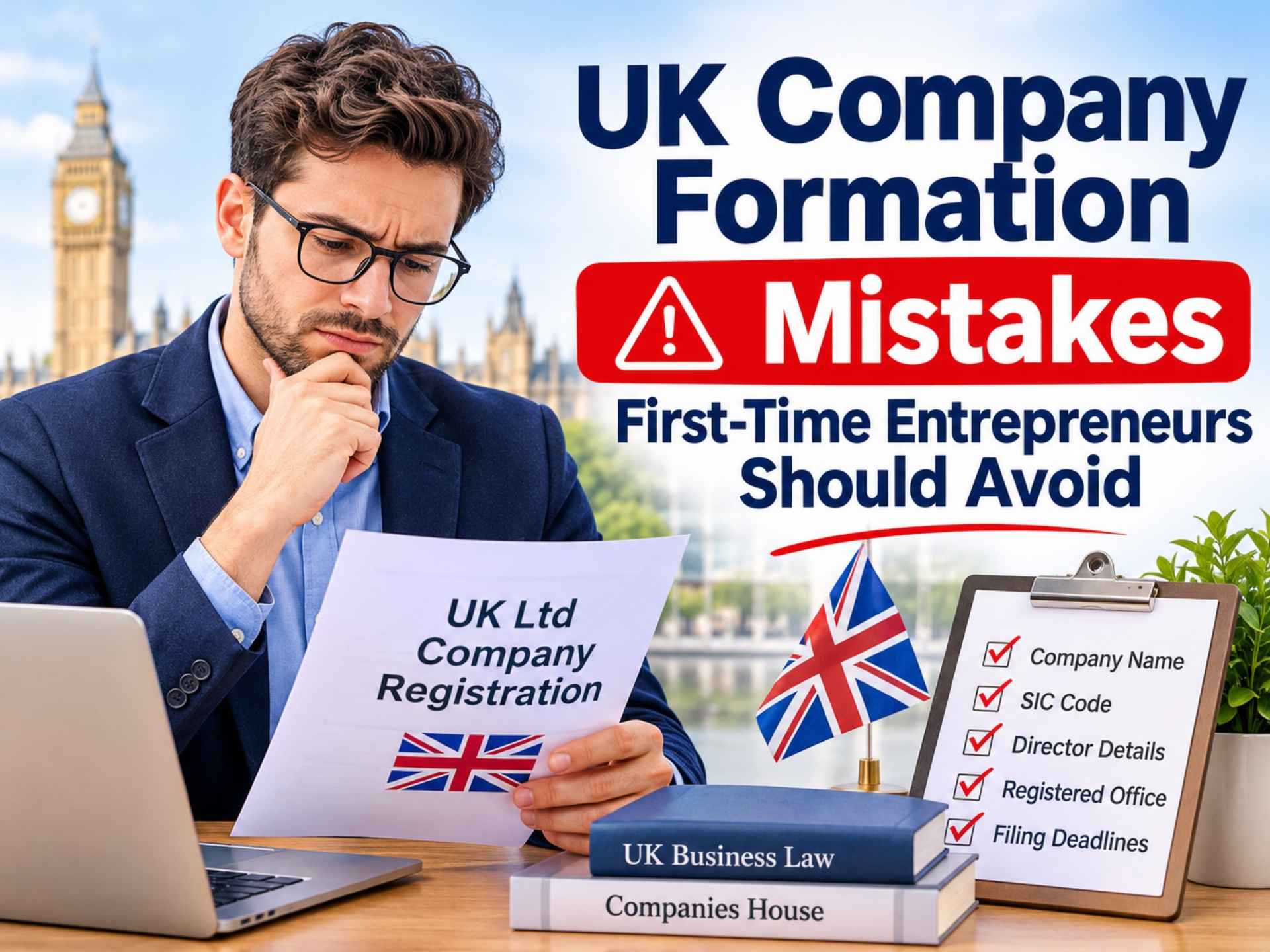
Starting a company in Britain is quick, and that speed is part of the problem. An application can take minutes to submit, so many first-time founders treat UK Ltd company registration as a form to fill in rather than a set of legal decisions. The choices made on that form follow the company for years. They appear on the public register, they shape what you must file, and some are awkward to change later.
This article walks through the mistakes that matter most when you set up a limited company in 2026, using guidance from GOV.UK, Companies House and official statistics.
Why is 2026 a good year to get the basics right?
The company register is busy and increasingly scrutinised. Companies House statistics show 815,277 company incorporations in the financial year ending March 2026, a rise of 1.67% on the previous year, while dissolutions rose faster, by 8.31%, to 787,120. The same release notes that Companies House increased its incorporation and registration fees on 1 February 2026.
Alongside this, the Economic Crime and Corporate Transparency Act has given Companies House stronger powers to challenge information on the register. Directors and people with significant control are now required to verify their identity, and the registered office rules were tightened in March 2024. Mistakes that once passed unnoticed are now more likely to lead to rejection, queries or penalties.
Mistake 1: Choosing a company name without checking the rules
A company name is the first thing the registrar reviews, and it is where many applications fail. GOV.UK explains that a new company cannot have a name that is the “same as” an existing one. The test is wider than an exact match. Names that differ only by certain punctuation, special characters, or words and characters that look or mean the same as another are treated as the same. GOV.UK’s own example is that “Hands UK Ltd” and “Hand’s Ltd” are the same as “Hands Ltd”. A same-as name can be registered only in limited cases, such as when the new company belongs to the same group as the existing one.
Sensitive words are the second trap. Companies House has explained that proposed names containing a sensitive word or expression are automatically stopped and then reviewed against the naming rules. Words implying a government link, a professional status or regulated activity generally need prior permission.
A third check is often skipped entirely. Companies House advises founders to check the UK Intellectual Property Office trade marks register, because a name that is free on the company register can still infringe a trade mark. Checking the name availability tool, the sensitive words guidance and the trade mark register before applying avoids delay and later disputes.
Mistake 2: Treating the SIC code as an afterthought
A SIC code (Standard Industrial Classification code) tells Companies House and the public what your company does. Companies House asks for at least one, and up to four can be listed. Founders often pick the first plausible option or a vague catch-all code to save time.
The better approach is to choose the code or codes that describe what the company will actually do. SIC codes feed into official statistics and are visible to banks, partners and other parties who look up your company. If your activity changes, the codes can be updated, but accuracy at the start avoids questions about what the company is really doing. If you plan to operate in a regulated activity, check whether a licence or authorisation is needed regardless of the code you choose.
Mistake 3: Getting director details wrong, or misunderstanding what becomes public
Every private limited company needs at least one director who is a real person aged 16 or over. Founders commonly confuse two different addresses. A director gives a residential address, which is held by Companies House but is not shown on the public register, and a service address, which is. The Companies Act 2006 requires directors’ service addresses rather than home addresses on the register, and the explanatory notes confirm that a director may use the company’s registered office as their service address.
The practical mistake is entering a home address as the service address without realising it will be public. Another is forgetting the identity requirement. From 18 November 2025, identity verification became mandatory for new directors and people with significant control, with a transition period for existing officers that runs to November 2026, according to Companies House guidance and news coverage. Founders should verify their identity before or during the application rather than discover the requirement when a filing is blocked.
Mistake 4: Using the wrong registered office address
The registered office is where official posts from Companies House and HMRC are sent, and it appears on the public register. GOV.UK states that it must be a physical address in the UK, in the same country the company is registered in. A company registered in Scotland needs a Scottish registered office. It must also be an “appropriate” address. In general terms, post sent there should reach someone acting for the company, and delivery should be capable of being acknowledged.
Since 4 March 2024, a Royal Mail PO Box cannot be a registered office, and GOV.UK extends that to similar services from other companies. Using your home address is allowed, but it becomes public. Using a third party’s address is also allowed, provided it meets the appropriate address conditions. Choosing an address purely because it is the lowest price is a risk, because an address that cannot reliably deliver your official mail is not compliant, and missed letters can lead to missed deadlines.
Mistake 5: Assuming cheap company formation means fewer obligations
Founders look for cheap company formation, and keeping start-up costs down is sensible. The risk is confusing a low upfront cost with a lighter legal burden. The Companies House fee is only the entry point. Once the company exists, it has the same statutory duties as any other limited company, whatever route was used to form it, and an agent filing on your behalf does not transfer responsibility away from the directors. Keep a record of what was filed and why, because the directors remain accountable for the accuracy of the register.
Mistake 6: Missing the filing obligations that begin on day one
This is the mistake with the sharpest penalties. In outline, GOV.UK sets out the following duties:
- Confirmation statement. The company must file one at least once every 12 months, confirming that the information held about it is correct. For a new company, the first review period starts on the date of incorporation.
- Annual accounts. Accounts are due at Companies House nine months after the company’s financial year ends. For a company’s first accounts, the deadline is 21 months after the date of incorporation.
- Corporation Tax. The company must register with HMRC within three months of starting to trade, pay Corporation Tax by the deadline for its accounting period and file a company tax return. These HMRC deadlines are separate from the Companies House ones.
Late filing carries automatic penalties, which GOV.UK sets out for accounts and tax returns, and persistent failure can lead to the company being struck off the register. Dormant companies are not exempt from filing. Set calendar reminders on the day the company is incorporated, and confirm each date on GOV.UK because the rules and amounts can change.
How can a first-time founder avoid these mistakes?
A short checklist covers most of the risk:
- Check the name against the register, the sensitive words list and the trade marks register before applying.
- Choose SIC codes that match what the company actually does.
- Decide which address will be public, and give the right one as the director’s service address.
- Confirm that the registered office meets the appropriate address test and is in the correct jurisdiction.
- Verify director and PSC identities early.
- Diarise the confirmation statement, accounts and tax deadlines from the incorporation date.
None of this makes it difficult to start a UK company or complete UK limited company formation. It means that the form takes minutes and the decisions behind it take thought, and the founders who spend an hour on those decisions save much more time later.