


Launching an e-commerce business is easier than it has ever been. You can build a website in a day, connect payment systems in minutes, and start selling products to customers around the world almost instantly.
But while getting started is simple, building an ecommerce business that actually grows is much harder.
So many e-commerce startups make the same early mistakes. Some are small oversights that slowly damage growth over time. Others can create bigger operational problems that become expensive to fix later. The good news is that most of these mistakes are avoidable, you just need to know how to spot them.
If you are building an ecommerce startup, these are some of the biggest issues worth paying attention to from the beginning.
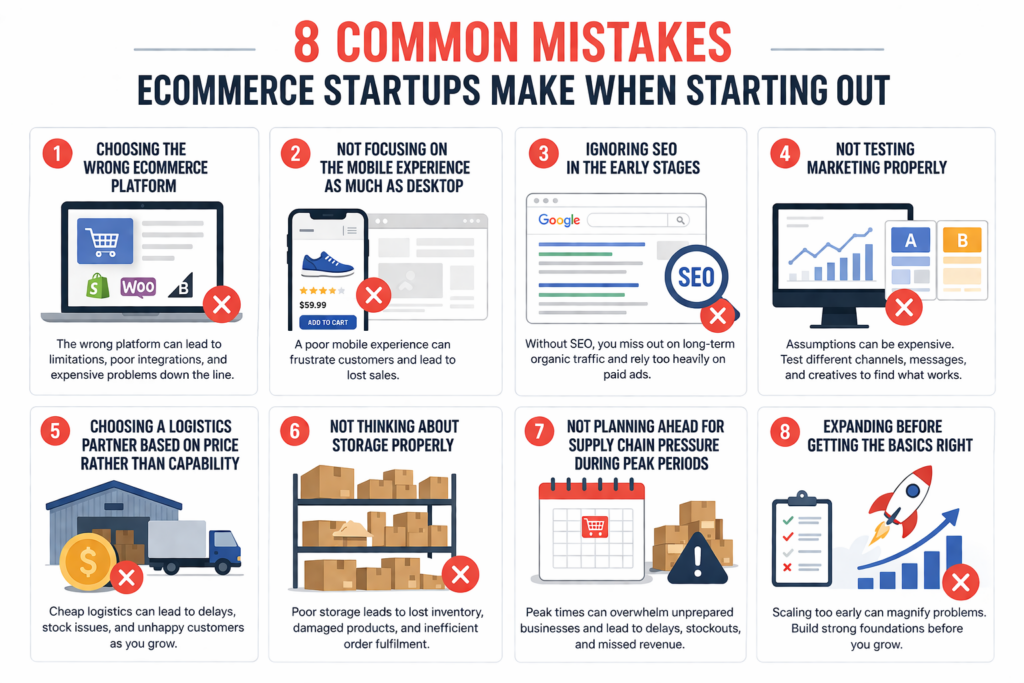
1. Choosing the wrong ecommerce platform
Not every ecommerce platform suits every type of business. Some startups choose based on popularity rather than what they actually need.
A platform that works perfectly for a small startup may become limiting later. Others may offer flexibility but need more technical management than founders expect.
Popular platforms like Shopify, WooCommerce, BigCommerce, and Adobe Commerce all serve different types of businesses. The wrong platform can create issues around integrations, checkout performance, SEO, or future scalability.
Changing ecommerce platforms later is rarely simple. It can affect search rankings, product data, customer journeys, and technical functionality. That is why founders benefit from thinking beyond launch.
The right ecommerce platform should not only work for today, but also support where the business is heading.
2. Not focusing on the mobile experience as much as desktop
Many founders build their ecommerce website on a laptop and naturally spend most of their time reviewing it on a desktop screen. The problem is that a huge percentage of ecommerce traffic now comes from mobile users.
People browse while commuting, shopping during lunch breaks, or scrolling social media in the evening. If your website works perfectly on desktop but feels clunky on mobile, you may lose customers before they ever reach checkout.
Small details make a difference. Slow loading pages, difficult navigation, awkward checkout forms, and poorly scaled images can quietly damage conversion rates. A customer might love your product, but if the buying experience feels frustrating on a phone, they will likely leave before purchasing.
The strongest ecommerce brands think mobile-first rather than desktop-first. They regularly test their site across different devices, look closely at how quickly pages load, and make sure checkout feels simple and friction-free.
Mobile ecommerce is no longer an add-on. For many brands, it is where the majority of customer journeys begin.
3. Ignoring SEO in the early stages
Many ecommerce startups focus heavily on paid advertising while completely overlooking SEO. Paid ads can drive quick traffic, but they stop the moment your budget stops.
SEO works differently. It builds visibility over time, helping your brand appear naturally when people search for products, buying guides, comparisons, or answers to niche questions.
The earlier ecommerce businesses start building SEO foundations, the stronger their position becomes.
Strong ecommerce SEO is not just about ranking products. It is about creating long-term discoverability.
4. Not testing marketing properly
One of the most common ecommerce startup mistakes is assuming you know what marketing will work before you test it. Founders often put their full budget into one channel too early.
They may decide paid ads are the answer, lean heavily into influencer marketing, or focus only on email campaigns without understanding what actually converts. Successful ecommerce brands rarely grow through guesswork.
Instead, they treat marketing like an ongoing experiment. Small adjustments to messaging, imagery, pricing, or audience targeting can completely change results.
A product that performs well on TikTok may struggle on Facebook. A customer may respond better to educational content than discount messaging. Even subtle changes to headlines or product imagery can improve conversion rates.
Marketing becomes stronger when brands test consistently.
The ecommerce businesses that grow fastest are usually the ones that are constantly learning from their audience rather than assuming they already know what works.
5. Choosing a logistics partner based on price rather than capability
For ecommerce startups, logistics often becomes an afterthought until orders begin increasing. In the early stages, founders are naturally cost-conscious.
They may look for the cheapest fulfilment option or select a warehouse provider based purely on monthly pricing. The problem is that logistics impacts almost every part of the customer experience.
If orders are delayed, stock is poorly managed, or communication breaks down, customers notice. Cheap logistics providers may struggle to scale, lack proper inventory systems, or fail to support businesses during busy periods.
What feels like a saving at the beginning can create operational problems later. A logistics partner should not simply store products. They should support growth.
For startups planning to grow, capability often matters far more than the lowest price.
6. Not thinking about storage properly
Many ecommerce startups begin by storing products wherever they can.
Boxes appear in spare rooms, garages, offices, and unused corners of the workplace. At first, this feels manageable, especially when comparing it with the cost of storage.
When order volumes are low, informal storage solutions can seem like a practical way to save money. The challenge comes when inventory grows.
Suddenly, products become harder to track, office space feels cluttered, packing orders becomes harder. Stock gets misplaced or damaged. Storage is often seen as a temporary issue, but for ecommerce businesses it is part of the wider infrastructure.
The earlier storage is treated as a long-term consideration, the smoother operations usually become.
7. Not planning ahead for supply chain pressure during peak periods
Many ecommerce startups underestimate how quickly demand can change.
Peak periods such as Black Friday, Christmas, product launches, and viral social media moments can create sudden spikes in orders. Without proper planning, supply chains can quickly fall behind.
The ecommerce brands that do well during busy periods are rarely reacting in real time, they are the ones that are planning for weeks or months in advance.
Supply chain planning is not just for big retailers, even small ecommerce startups benefit from thinking ahead. Preparing for demand before it happens can protect revenue, customer experience, and long-term reputation.
8. Expanding before getting the basics right
Growth can be exciting. Once sales start increasing, it is natural for founders to think about launching more products, entering new markets, or increasing advertising spend.
But expansion can make existing problems even bigger. If customer service struggles at small order volumes, it will struggle even more at larger ones. If inventory tracking is inconsistent, growth can quickly create chaos.
Many ecommerce startups scale too early because growth feels like the obvious next step. In reality, strong businesses often spend time improving operations before pushing forwards.
Scaling works best when the basics are already working well. Without strong foundations, growth can become stressful rather than sustainable.
Building an ecommerce startup
Building an ecommerce startup is rarely straightforward and there will always be mistakes along the way.
But many of the most common ecommerce problems come from rushing decisions or overlooking the operational side of growth.
The businesses that scale most effectively are often the ones that take the time to get the basics right early on. For ecommerce startups, avoiding these mistakes can make growth smoother, more sustainable, and far less stressful over the long term.


